
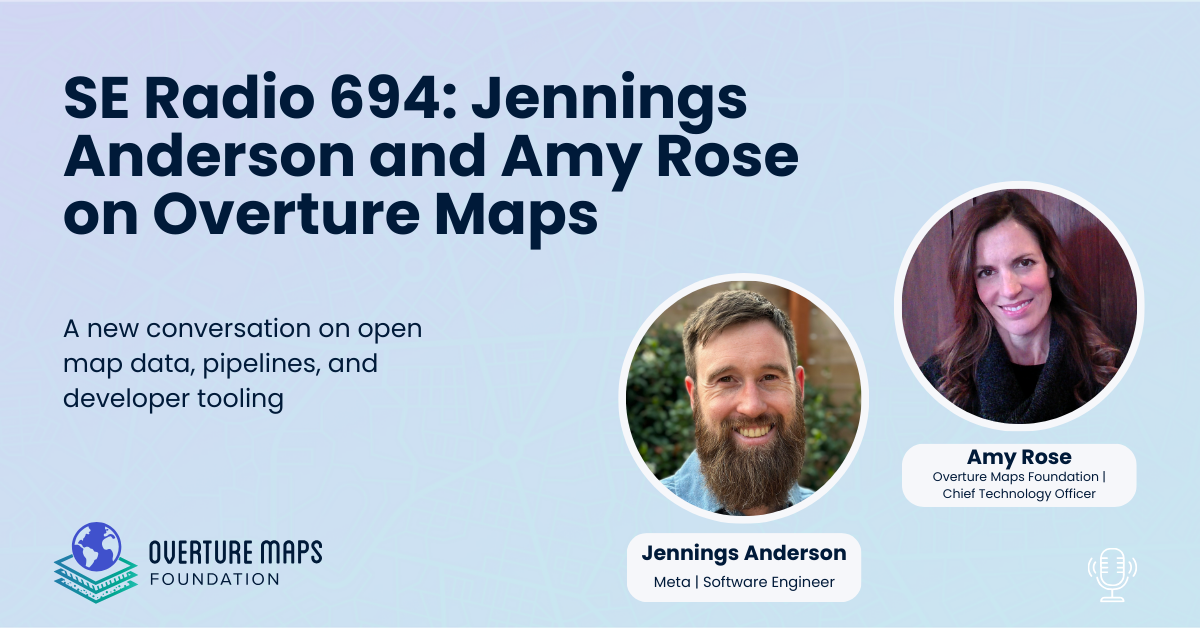
The Overture Maps Foundation is now three years old, and we’ve met every milestone we’ve set out to meet. But there’s still much more to come. Please enjoy this interview with Software Engineering Radio’s Gregory Kapfhammer and Amy Rose, Overture CTO, and Jennings Anderson, software engineer at Meta. It is one of the best, most complete overviews of Overture’s progress and goals to date.
In it, you’ll learn:
- Core concepts associated with geospatial data and why geospatial data platforms are a sort of “super-powered map” akin to any other kind of information system.
- The importance of map data being normalized to one schema, which describes the structure of the data, and enables consistency when dealing with different data sources that may have unique ways of describing things. Without a common schema, users spend too much time converting data before they can even use it. Overture does that upfront work for everyone’s benefit.
- That Overture’s dataset includes 4.2 billion features across buildings, transportation, addresses, divisions (administrative boundaries), places, and base layers.
- The benefit of a cloud native format making it easier to access the data.
- New uses of Overture map data, including by Instagram as part of Meta’s plan to power all of its maps with Overture data.
- Why an interoperable open ecosystem like Overture fosters the collaboration needed to create and maintain geospatial global data sets, especially in a rapidly and constantly changing world, so that everybody can innovate on top of the base layer.
- Why Overture’s Global Entity Reference System, or GERS, defines each entity in the Overture data set with a unique ID to enable data interoperability. With unique IDs, it becomes easier to find entities and attach outside data sources to the right entity: such as weather forecasts for an outdoor dining venue. When real-world conditions change, the GERS registry tracks the change.
- Why geospatial data is like any other data and should be easily used by a wide variety of tools and professionals, not just those in geospatial circles.
- The role of the Linux Foundation in providing a neutral, vendor agnostic home for Overture Maps so it can remain open and collaborative.
Thanks to Amy and Jennings for the wonderful overview!
Join the Overture Community
The future of mapping is open, collaborative, and built together. Join us in making it happen. Visit our website to learn more about our work and become a member.
Stay connected: follow us on LinkedIn, X, and Bluesky for the latest updates. Sign up for Overture’s monthly newsletter for the latest updates on our journey in transforming map data distribution.
Interested in using Overture data? Check out the Explorer tool, a no-code option for inspecting Overture data and metadata, the data guides for an overview of our six data themes, and the “Getting Data” section of our documentation.