
Overture Maps Foundation participated in GeoBuiz Summit 2026 from January 12 to 14, joining leaders across industry, government, and academia to discuss the future of open, interoperable geospatial data and the shared infrastructure needed to support it.
Across sessions and conversations, a consistent theme emerged. Fragmentation remains one of the biggest challenges in geospatial data. Organizations continue to spend significant time and resources reconciling disparate datasets, aligning schemas, and managing integration complexity. Many participants expressed growing interest in shared foundations that reduce duplication and make innovation easier.
Overture’s participation focused on both strategic and communications perspectives on how geospatial data is built, shared, and understood.
Why Shared Infrastructure Matters
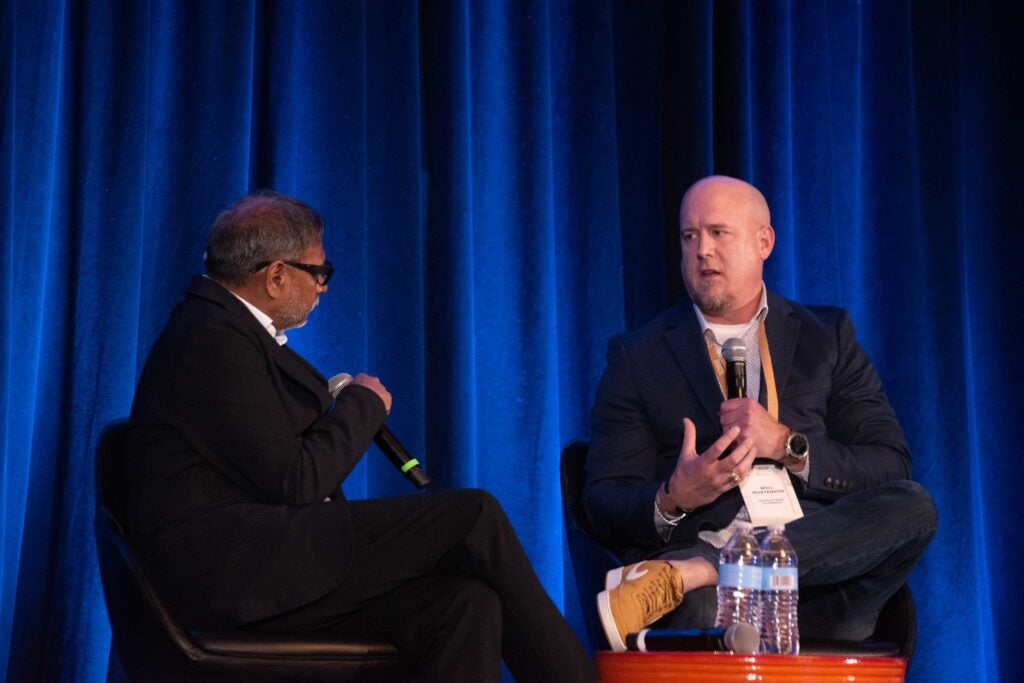
On January 12, Will Mortenson, Executive Director of Overture Maps Foundation, joined a main stage fireside conversation focused on the future of geospatial data infrastructure.
Will drew on nearly three decades of experience across government and industry, including roles with the U.S. Army and the National Geospatial-Intelligence Agency. He described a persistent challenge he has seen throughout his career: the same real world features are often modeled, labeled, and managed differently across organizations. This leads to duplication, friction, and unnecessary cost.
He explained how Overture is addressing this problem by providing a common foundation of map data, a consistent schema, and the Global Entity Reference System (GERS), which assigns unique identifiers to real world entities. This approach makes it easier for organizations to connect different datasets, reduce redundant work, and focus on building differentiated value.
Will also emphasized that Overture’s data and tools are open and publicly available, updated regularly, and designed to support a wide range of use cases across sectors. Conversations with attendees reflected growing recognition that collaboration around shared infrastructure is becoming increasingly important as the ecosystem scales.
The recording of the fireside conversation with Will is available.
 Making Complex Technology More Accessible
On the same day, Nora Anwar, Senior Community Manager at Overture Maps Foundation, spoke at the MarComms Summit on the role of storytelling in advancing collaboration and adoption of shared geospatial infrastructure.
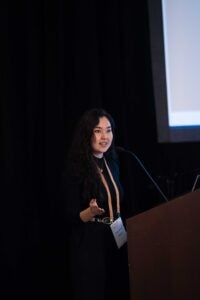 The session traced Overture’s journey from being perceived as simply another open dataset to being understood as a collaborative foundation that enables interoperability across organizations. It highlighted how clear communication has helped clarify what Overture is, how participation works, and why a shared approach benefits the entire ecosystem.
Nora also discussed how storytelling surfaces common industry challenges, including the increasing cost of data onboarding and reconciliation that continues to slow innovation. By bringing together more than 40 public, private, and nonprofit organizations and giving members space to share their perspectives, Overture has been able to build trust and align stakeholders around a shared goal.
The session reinforced a broader takeaway. In a complex ecosystem, shared understanding is essential to meaningful collaboration.
Continuing the Conversation
Amy Rose, Chief Technology Officer at Overture Maps Foundation, was also on site throughout the summit, connecting with attendees interested in Overture’s technical architecture, data layers, and future roadmap.
 Beyond the formal sessions, many conversations at GeoBuiz focused on practical questions. How can organizations reduce the cost of data onboarding ? How can governments and industry collaborate more effectively? How can the ecosystem move toward shared standards without limiting innovation?
The discussions at GeoBuiz reinforced that the need for open, interoperable foundations is widely recognized. Overture’s role is to help make that collaboration practical.
To learn more about open foundational map data, explore Overture’s data here and the Global Entity Reference System (GERS).
Join us at the Member Summit
Members of the Overture Maps Foundation come together each year at the Overture Maps Member Summit to exchange ideas, strengthen collaboration, and help shape the project’s direction. The 2026 Overture Maps Foundation
Member Summit will take place in Florence, Italy, from April 21 to 23, and will focus on advancing shared goals through discussion and community engagement.
The Call for Proposals is now open, and registration is available for members. If you are interested in contributing to this work, you can learn more about becoming a member.