LLMs are highly capable at many things, but understanding the physical world isn’t one of them.
Today, ChatGPT recommends just 1.2% of all local business locations, and 83% of restaurants are completely absent from AI-generated recommendations. For AI product managers and engineers building agentic workflows, this is a practical hurdle. If an AI agent cannot reliably handle local information, its usefulness for real world tasks hits a hard ceiling.
Overture Maps Foundation is working to change that, by building the open spatial and location graph that AI systems need to reason reliably about the real world.
Inherent model limitations
The core challenge is that LLMs learn about the world primarily through text, which is an uneven record of reality. When AI systems try to process location data, they run into a few structural roadblocks:
- Stale knowledge: Training data has a cutoff, but the physical world doesn’t. Businesses open and close, roads reroute, addresses change. Once a model is trained, its picture of the world starts decaying immediately.
- No spatial reasoning: LLMs can describe places but can’t reason over them. Asking which businesses operate inside a specific building footprint, or which roads connect two neighborhoods, requires a structured spatial graph, not a body of text.
- Lack of ground truth: Without a canonical reference for what exists where, models invent places that don’t exist, miss places that do, and attach the wrong attributes to the right locations.
- Inconsistent identities: LLMs struggle to verify whether a digital property belongs to the real-world entity being referenced, returning illegitimate URLs for major brands 34% of the time.
A shared foundation for AI grounding
To address these recall and hallucination issues, AI models require a structured, verifiable grounding layer for spatial retrieval-augmented generation. This provides a trusted source of geospatial facts and relationships the model can pull from, rather than guessing or making its own approximations.
But spatial and location data is fragmented: the same restaurant can appear in a dozen datasets under slightly different names and coordinates. Every AI team that wants to accurately ground its model in the physical world ends up solving the same cleaning and deduplication problem.
This is what Overture is aiming to fix. At the center of its approach is the Global Entity Reference System (GERS).
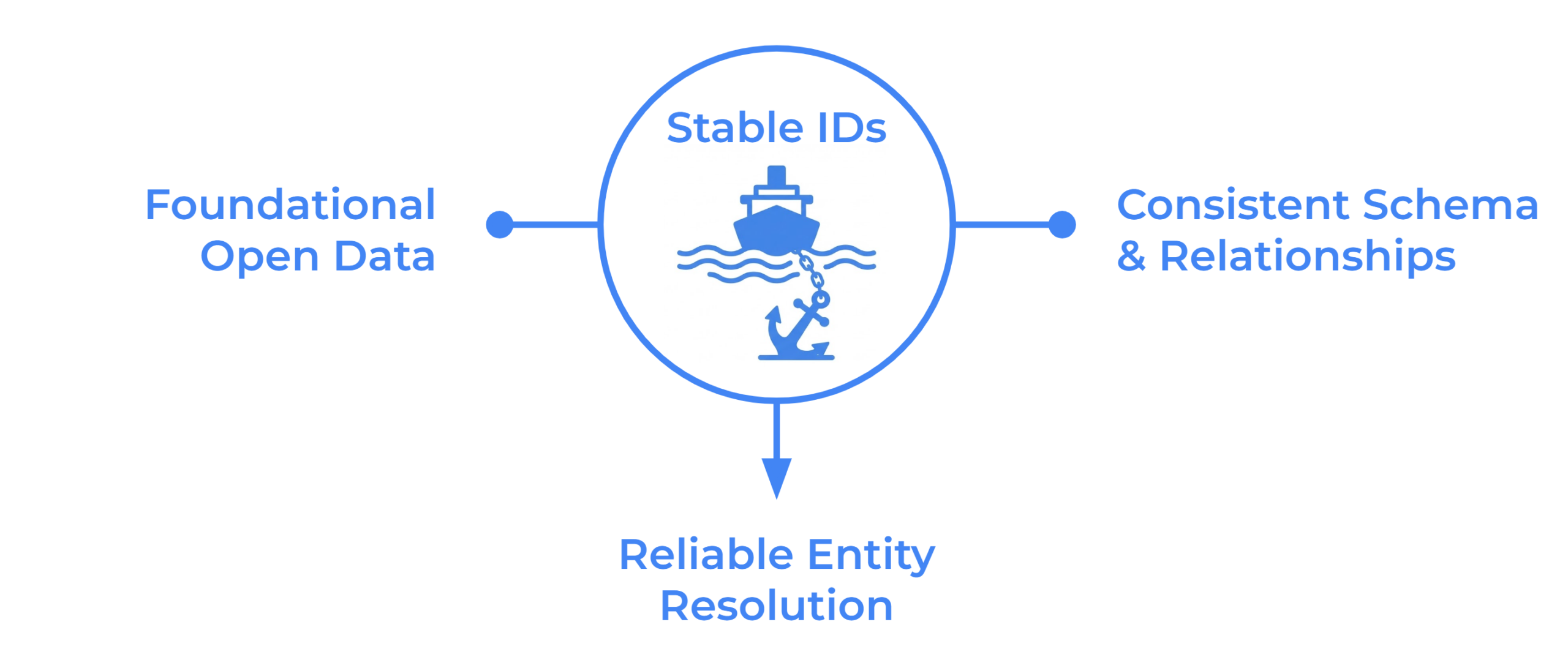
GERS acts as a universal ID system for the physical world. Because every place, road segment, and administrative boundary has a stable, resolvable ID, developers can build reliable entity resolution directly into their AI pipelines. Rather than relying on an LLM to probabilistically guess if a URL matches a real-world entity, AI data pipelines can anchor their knowledge to a persistent GERS ID.
Finally, data needs consistent schemas, clear relationships, and machine-readable formatting. By structuring spatial and location data with a predictable taxonomy (enforced via tools like Pydantic), Overture gives LLMs the “linguistics of spatial and location data.” This requires fewer tokens and less prompt engineering, allowing AI to retrieve, reason over, and combine information reliably rather than hallucinating connections.
Build with Overture today
Overture Maps Foundation is actively building the open data, ID system (GERS), schemas, and pipelines needed to support spatial AI grounding. Here is what is available for data teams right now:
- Cloud-native formats: Access continuously updated spatial and location data in cloud-optimized formats like GeoParquet that can be natively and efficiently read. These formats enable low-latency queries from cloud storage, drastically lowering the compute costs required to serve edge and scalable AI models.
- Overture Schema: The schema is authored as Pydantic models, bridging the semantic gap between raw data and human understanding while enabling machine-actionable workflows.
- Data Guides & Definitions: Check out our documentation on data themes including Places, Buildings, and Transportation to see how you can start integrating this data via our “Getting Data” guides.
- Overture Explorer: Product managers and engineers can visualize and explore Overture’s data directly using our web-based Explorer tool.
Join the Overture Community
Overture is focused on providing a structured, vendor-neutral data foundation to help ensure future AI systems are accurately anchored in physical reality.
Join the Overture Maps Foundation as a member to shape how AI and LLMs get grounded in the real world. Visit the Overture website to learn more about how your organization can become a member. To stay updated on our latest schema releases and AI tooling, sign up for our monthly newsletter or follow us on LinkedIn, X, and Bluesky.