Artificial Intelligence is fundamentally transforming how we search, analyze, and build. But as developers push LLMs into more complex enterprise applications, they keep running into a fundamental blind spot: LLMs hallucinate when reasoning about physical space and location.
Why? Because while LLM providers scrape the internet for text to pre-train their models, that data is static, fragmented, and often disconnected from reality. To function reliably, AI needs a local anchor at inference time. It needs an authoritative pipeline of “real world” data.
Why LLMs fail at the physical world
When developers try to build spatial reasoning into AI agents, they collide with structural roadblocks. LLMs learn primarily through text, which provides an uneven record of reality.
- Stale knowledge: The physical world is highly dynamic. Businesses close, addresses change, and roads reroute daily. AI models rely on frozen training data with strict cut-offs. Once trained, a model’s picture of the world begins decaying immediately.
- No spatial reasoning: LLMs describe places but lack situational awareness to reason over them. Answering questions about which businesses operate inside a specific building footprint requires a structured spatial graph.
- Lack of ground truth: Models invent nonexistent places and miss real ones. Without a canonical reference, AI confidently guesses and hallucinates.
- Inconsistent identities: LLMs struggle to verify if a digital property belongs to a real-world entity. They return illegitimate URLs for major brands 34% of the time.
Grounding AI for the physical world with Overture
AI models require a structured, verifiable grounding layer for spatial retrieval-augmented generation. This provides a trusted source of geospatial facts to prevent hallucinations. Find out how Overture is building the open spatial and location graph necessary for AI systems to reason reliably about the real world.
AI startups grounding AI with Overture
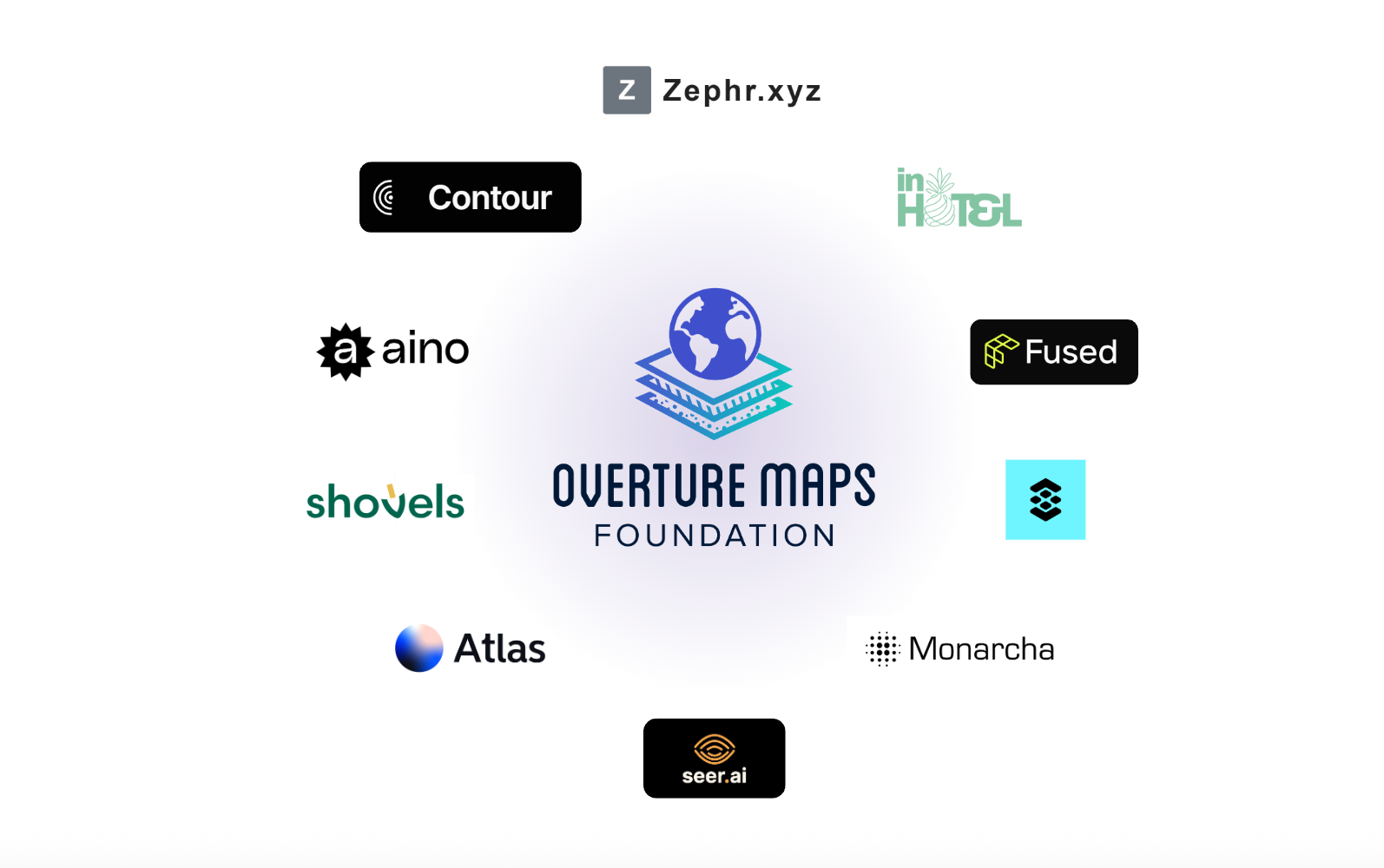
Here is a look at 10 AI startups leveraging our spatial and location data to inspire the next generation of physical-world intelligence.
- Zephr: “Trust Mechanism” via Computer Vision
Bridging visual reality and digital maps using street-level imagery to give AI models an egocentric spatial understanding of the world.
Zephr acts as a validator for Overture’s data. By processing dashcam or mobile imagery at the edge, their vision-language models can instantly cross-reference a recognized store logo or building facade with Overture’s Places and Buildings themes. They deterministically anchor these findings to Overture Places via GERS ID. If the “real world” data changes (like a new storefront opening), Zephr can actively verify it and push high-confidence signals back into Overture’s feedback loop, essentially serving as a continuous, automated quality audit for AI ground truth. These data relationships can then be encoded as embeddings that allow AI models to visually describe the world from a user’s view point (right/left, front/behind, across the street, going in the right/wrong direction).
- InHotel: Operating System for Agentic Hospitality
Platform accelerating hospitality’s transition to AI-driven operations by connecting legacy systems, destination partners, and traveler AI agents.
inHotel enables hotels, restaurants, tour operators, and car rental agencies to turn map listings into interactive AI endpoints and enable interoperability through A2A and the GERS API. This creates a trusted foundation for traveler AI agents to discover verified local providers and facilitate direct bookings. Agents collaborate with nearby partners, helping keep engagement and revenue within local communities. Geospatial grounding ensures every agent operates on authoritative location data for reliable AI-to-AI coordination and transactions.
- Fused: Serverless Spatial Reasoning on the Fly
Modern geospatial toolkit utilizing serverless architecture to run Python-based user defined functions.
Fused powers inference-time grounding (Retrieval-Augmented Generation) for AI by dynamically streaming Overture’s cloud-native GeoParquet files. Instead of an AI startup needing to download and host a 500GB+ global database, Fused enables LLMs to query only the necessary bounding box. For example, an AI model analyzing disaster risk can instantly pull Overture’s building footprints just for a specific flood zone in real-time, executing deep learning object detection against fresh “real world” data without massive compute overhead.
- VOYGR: Real-world place intelligence for AI apps and agents
Comprehensive, up-to-date information about places and local businesses for AI apps and agents.
VOYGR is the map intelligence API layer every AI app and agent will need. Maps say ‘4.2 stars, open till 10 – VOYGR knows the chef left, wait times doubled, and locals moved on. Their intelligent local search combines accurate place data with fresh web context – news, articles, and events – expanding beyond 10-15 map attributes into an infinite, queryable place profile. Developers use VOYGR’s Validation and Enrichment APIs to retrieve confidence scores and additional attributes for Overture Place data. These checks prevent AI hallucinations and catch fatal flaws before they reach production.
- Monarcha: Translating Natural Language into Spatial Reality
Natural language search and retrieval for complex map datasets.
Monarcha indexes the entire Overture schema into a vector database. Because Monarcha leverages Overture as a cross-linked graph (connecting e.g. Addresses to Places to Transportation networks), LLMs can successfully navigate spatial reasoning. If a user asks, “Show me all the pharmacies within a 15-minute walk of this specific elderly care center,” the AI extracts the boundaries, understands the pedestrian routing, and queries the “real world” data to build interactive visualizations without a single line of SQL.
- Seer.ai: Spatiotemporal Data Streaming for AI
Cloud-native spatiotemporal data mesh and fusion platform designed to eliminate rigid ETL pipelines.
Seer exposes Overture’s data in AI-compatible formats (like vector tile tokens) via simple APIs. This provides the plumbing needed for AI developers building localized social apps or delivery dispatch agents. By instantly streaming Overture’s standardized spatial and location data on the fly, Seer is proving the immediate ROI of adopting open data and standards for rapid AI prototyping.
- Atlas: Conversational Mapmaking via Agentic GIS
AI-native geospatial platform enabling teams to generate interactive maps and automated workflows through natural language.
Atlas utilizes its AI copilot, Navi, to eliminate the technical friction of traditional desktop software by generating map layers directly from user conversations. To ensure these conversational prompts translate into accurate spatial insights, Atlas provides native, one-click integration with Overture Maps. Overture acts as a structured grounding layer for Navi, allowing the AI to instantly query and style global themes like Buildings and Transportation without data prep.
- Shovels: Decoding the Built Environment
Building an intelligence layer over highly unstructured, historically messy municipal building permit data.
Municipal permits can have inconsistent addresses and formatting. Shovels uses specialized LLMs to parse and clean millions of historical permits and anchors this semantic data directly with Overture’s building footprints and GERS IDs. Now, AI models used by B2B clients (like solar installers or HVAC contractors) can identify homes that recently upgraded (or never upgraded) their roofs, performing hyper-targeted marketing based on highly-confident real world data.
- Aino: Spatial Intelligence for Planning and Development Teams
Aino helps urban planning and development teams run spatial analysis using a natural language interface. No GIS expertise required.
Aino builds the spatial analytics layer for professional teams in the built environment. They use Overture’s Places and Transportation themes as foundational ground truth for site analysis and location intelligence. When planning studios evaluate new commissions or development teams screen acquisition pipelines, Aino’s AI uses Overture’s spatial data to run complex multi-modal accessibility analysis, competitive density mapping and urban context assessments automatically, without GIS expertise.
By combining Overture’s Places and street network data with demographic, zoning and environmental sources, Aino delivers structured, source-tracked findings that go directly into client presentations, planning submissions and investment memos. Every output is traceable back to the original dataset, built for teams where every spatial decision needs to be defensible.
- Contour: Autonomous Workflows via MCP
Open source platform bridging natural language processing and complex spatial analysis.
Contour illustrates the general push toward ecosystem standardization. By utilizing Model Context Protocol integrations, Contour provides general-purpose AI assistants with access to query Overture’s global data. If a supply chain manager prompts the AI to “reroute shipments around the recent bridge closure in Baltimore,” the AI uses Contour to seamlessly query Overture’s Transportation network, autonomously adjusting logistics based on verified spatial and location data.
The spatial & location foundation of AI is open
These 10 AI startups demonstrate a general industry shift towards collaborative, open, and universally accessible spatial and location grounding for AI and LLMs.
Organizations are adopting GERS because they want their knowledge about the world to inform the “authoritative truth” for the next generation of AI. Overture is the fundamental infrastructure that makes reliable AI innovation possible in the physical world.
Ready to ground your AI?
- Explore Overture’s vision for open spatial & location grounding,
- Join Overture to shape how AI and LLMs get grounded in the real world. Visit the Overture website to learn more about how your organization can become a member.
- Explore Overture’s reference data & system through our developer documentation.
- To stay updated on our latest schema releases and AI tooling, sign up for our monthly newsletter or follow us on LinkedIn, X, and Bluesky.